Whoa! I still remember the first time I dug into a raw Solana transaction and felt totally lost. My instinct said there had to be a better way to read on-chain activity than guessing from logs. Initially I thought explorers were all the same, but then Solscan surprised me — and not just with prettier charts. Over time that surprise turned into reliable workflows I use daily, and somethin’ about the interface just clicks for me.
Okay, so check this out—Solscan isn’t just a block-and-tx viewer. It’s a token tracker, analytics hub, and incident triage tool rolled into one. Medium-level insight: you can track token holders, watch swaps, and pivot quickly between address, token, and program views. Longer thought: when you’re troubleshooting a failed instruction or trying to attribute a subtle liquidity shift to a whale or a bot, those cross-linked pages and rapid filters save minutes that otherwise turn into hours of manual tracing, which gets old fast.
Seriously? Some explorers feel like academic tools — dry and slow. Solscan feels lively. The token pages show distribution charts, holder lists (with percentages), and recent transfers. The analytics tab surfaces network-wide metrics like TPS and fee trends, which help you contextualize whether a spike in failures is systemic or just bad timing. I’m biased toward tools that let me pivot without reloading, and Solscan does that very very well.
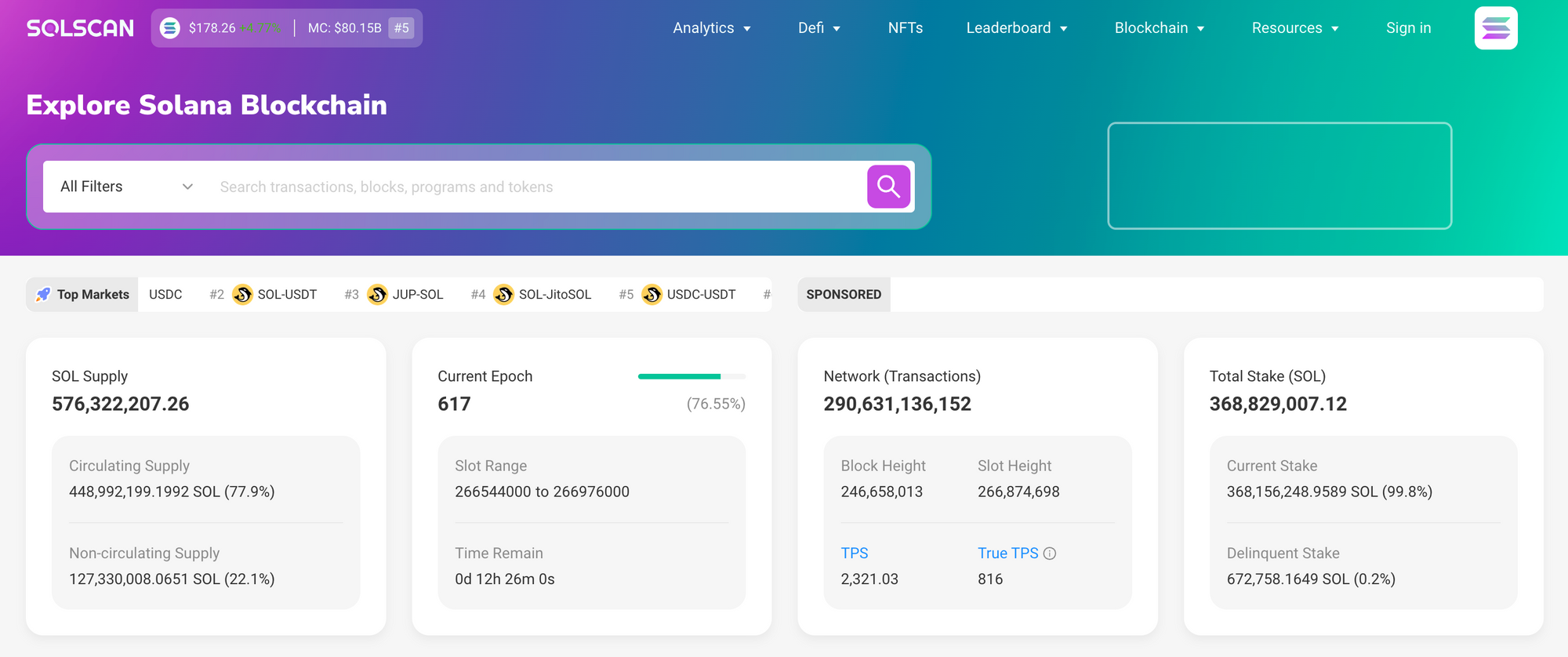
How I use Solscan to analyze tokens and transactions
Here’s the thing. My routine usually starts at the token page. I look for verification badges, then scan mint activity, holders, and recent transfers. The practice helps me answer three quick questions: is this token active, who are the big holders, and are transfers organic or concentrated? Initially I thought those questions were trivial, but actual on-chain patterns often contradict surface narratives — so the deeper drill matters. On one hand, a token with many holders seems healthy; though actually hold percentages and age-of-hold matter more, and the holder-activity timeline on Solscan surfaces that nuance.
Hmm… when inspecting transactions, the instruction breakdown is my favorite feature. You get readable program calls with decoded arguments for common programs (spl-token, serum, token-swap). That decoding is a small thing but it reduces guesswork immensely. Longer thought: when a swap fails, seeing the exact instruction and pre/post balances means you can tell whether the problem was a price slippage, rent exemption, or an authority mismatch — and that often points you at the right dev or forum thread to follow up with.
On analytics — Solscan aggregates TPS, confirmed blocks, and recent fee averages. That data matters when you plan drops or migration windows. If fees and congestion are trending up due to a new NFT mint, you might delay an airdrop or change your signature batching strategy. I’m not 100% sure every metric is perfectly tuned for every edge case, but it’s a pragmatic snapshot that informs operational decisions.
Where Solscan shines — and where it doesn’t
Short: holder analytics, quick decoding, and UX. Medium: export options, CSV for transfers, and the ability to follow an address’s entire activity trail. Long: when incident response is required — say a token bridge shows odd flows — the combination of program-level decoding, holder snapshots, and the ability to trace through swaps and associated fee-payers lets you build a timeline fast, which is crucial when community trust is at stake.
On the flip side, indexing lags can occur during cluster stress. Really — there are moments where the latest slot isn’t instantly reflected. My working approach is to cross-check with multiple sources if timing is critical (RPC queries, dev tools). I’m comfortable admitting that sometimes Solscan’s derived analytics smooth over edge-case noise, which is great for clarity but can hide microsecond ordering details you might need when debugging front-running bots.
Something felt off about a token flow once and my gut said “look deeper.” Initially I relied solely on the explorer view, but actually, wait—let me rephrase that—pairing Solscan’s UI with a raw RPC query clarified sequence-of-transfers that the explorer visualized but didn’t timestamp precisely. So: use it as a primary tool, but don’t treat it as the single source for forensic timestamps when you absolutely need nanosecond ordering.
Practical tips and tricks
Short tip: use the “export” button on token holder tables. Medium detail: exporting CSVs of holders or transfers helps with snapshot-based airdrops or compliance checks. Longer thought: if you’re running analytics pipelines or audits, grabbing CSVs and combining them with program logs from RPC gives you a reproducible audit trail — and being able to recreate the state helps in communities where trust and transparency matter.
Another trick: use the program pages to learn how a smart contract interacts across events. I watch program-level activity to spot new wallets interacting with a protocol; that can reveal onboarding patterns or emerging bot behavior. I’m biased toward behavioral signals, and this is where Solscan’s cross-linking between transactions, addresses, and programs really helps.
Also — (oh, and by the way…) you can set up alerts or monitor particular addresses via third-party tools that integrate with explorer outputs. It’s not built-in in a heavy way, but the available data formats make hooking into notification services straightforward.
Where to find the official Solscan explorer
When you’re ready to try this in your own workflow, the official Solscan landing and helper pages are a practical starting point: https://sites.google.com/cryptowalletextensionus.com/solscan-explorer-official-site/ — use that to bookmark, verify badges, and explore API docs if you plan automation. My recommendation: start with a few tokens you follow, export their holders, and try piecing together a transfer timeline for a single incident to learn the ropes.
I’ll be honest — what bugs me is when people treat explorers like crystal balls. They aren’t. They’re lenses that highlight certain on-chain truths and obscure others. But for day-to-day Solana work, Solscan is one of the most practical, approachable lenses I’ve used, and it’s kept maturing in useful ways.
FAQ
Q: Is Solscan secure to use?
A: Yes — it’s a read-only explorer. You never need to connect your wallet to view transactions or token data. However, be cautious with any links or external tools that ask for signatures; explorers display data, they don’t ask for authority. If you export CSVs, keep them safe if they contain sensitive addresses or labels.
Q: Can I use Solscan data for automated tools?
A: Absolutely. Solscan offers endpoints and exportable formats that are friendly for pipelines. That said, for high-fidelity forensic needs combine Solscan views with direct RPC queries for exact sequencing and raw logs.
Bir yanıt yazın